- Introduction
- Configuring checks
- Configuring notifications
- Projects and teams
- Badges
- Pinging API
- Management API
- Reliability Tips
- Shell scripts
- Python
- Ruby
- PHP
- Go
- C#
- Javascript
- PowerShell
- Monitoring cron jobs
- Signaling failures
- Measuring script run time
- Attaching logs
- Cloning checks
- Configuring Prometheus
- Third-party resources
- Overview
- Configuration
- Running with Docker
- Cron syntax cheatsheet
Attaching Logs
DL7MLP Monitoring Project ping endpoints accept HTTP HEAD, GET and POST request methods.
When using HTTP POST, you can include an arbitrary payload in the request body. DL7MLP Monitoring Project will log the first 10 kilobytes (10 000 bytes) of the request body, so that you can inspect it later.
Logging Command Output
In this example, we run certbot renew, capture its output (both the stdout
and stderr streams), and submit the captured output to DL7MLP Monitoring Project:
#!/bin/sh

m=$(/usr/bin/certbot renew 2>&1)
curl -fsS -m 10 --retry 5 --data-raw "$m" https://health.dl7mlp.de/ping/your-uuid-here
In Combination with the /fail and /{exit-status} Endpoints
We can extend the previous example and signal either success or failure depending on the exit code:
#!/bin/sh

m=$(/usr/bin/certbot renew 2>&1)
curl -fsS -m 10 --retry 5 --data-raw "$m" https://health.dl7mlp.de/ping/your-uuid-here/$?
Using Runitor
Runitor is a third party utility that runs the supplied command, captures its output and reports to DL7MLP Monitoring Project. It also measures the execution time and retries HTTP requests on transient errors. Best of all, the syntax is simple and clean:
runitor -uuid your-uuid-here -- /usr/bin/certbot renew
Sending Logs Without Signalling Success or Failure
You may sometimes want to log diagnostic information without altering the check's current state. DL7MLP Monitoring Project provides the /log endpoint just for that. When you send an HTTP POST request to this endpoint, DL7MLP Monitoring Project will log the event and display it in check's "Events" section, but will keep the check's state unchanged.
Handling More Than 10KB of Logs
While DL7MLP Monitoring Project can store a small amount of logs in a pinch, it is not specifically designed for that. If you run into the issue of logs getting cut off, consider the following options:
- See if the logs can be made less verbose. For example, if you have a batch job that outputs a line of text per item processed, perhaps it can output a summary with the totals instead.
- If the important content is usually at the end, submit the last 10KB instead
of the first. Here is an example that submits the last 10KB of
dmesgoutput:
#!/bin/sh

m=$(dmesg | tail --bytes=10000)
curl -fsS -m 10 --retry 5 --data-raw "$m" https://health.dl7mlp.de/ping/your-uuid-here
- Finally, if it is critical to capture the entire log output, consider using a dedicated log aggregation service for capturing the logs.
Where to See Captured Logs
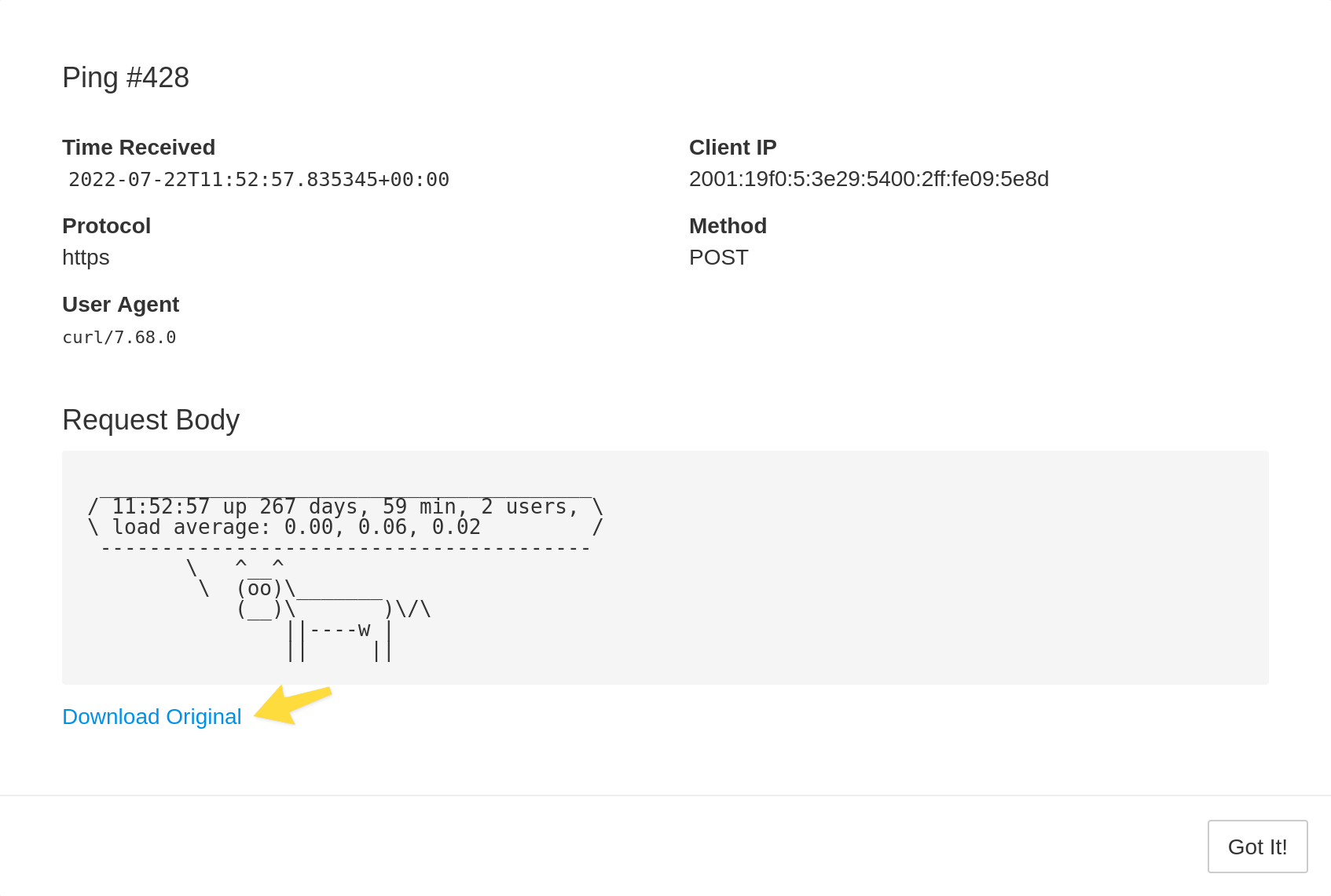
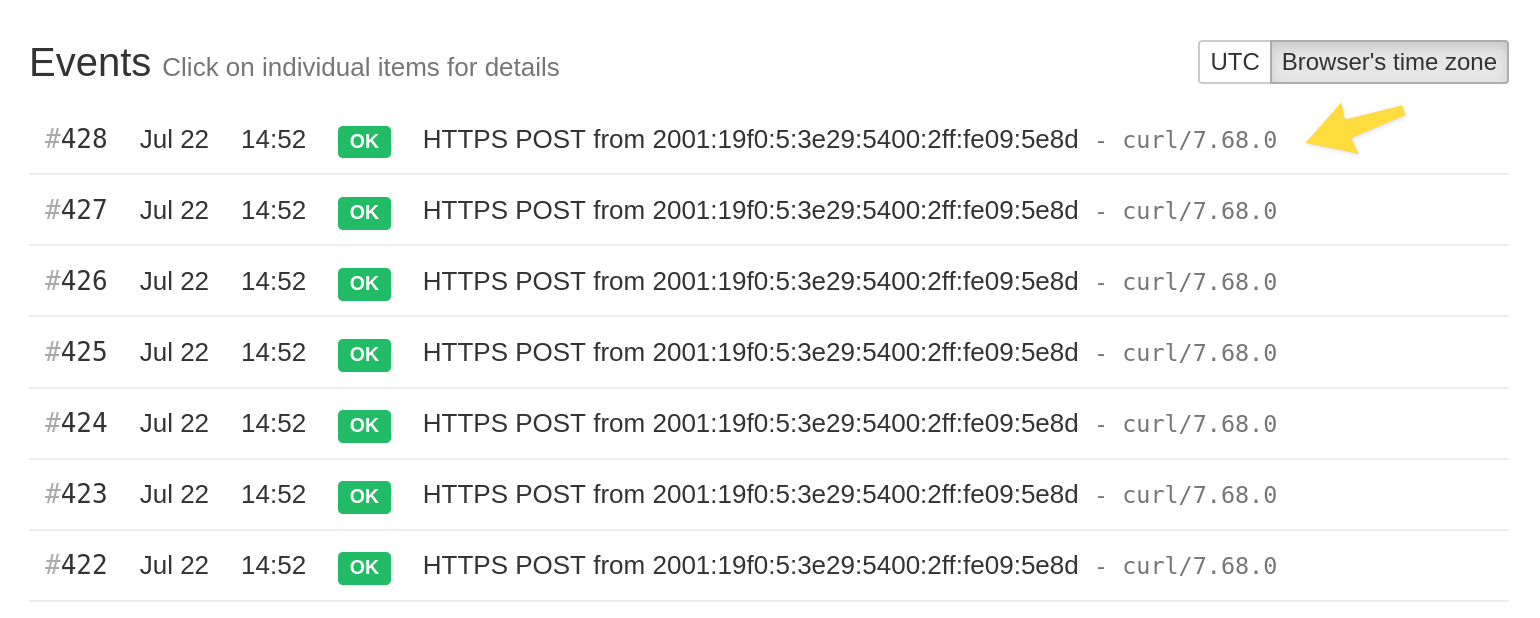
In the check's details page, Events section, click on individual events to see full event details, including the captured log information.
In the dialog that opens, use the "Download Original" link to download the request body data, exactly as it was submitted to DL7MLP Monitoring Project: